Why Broken Habit Streaks Backfire (and What Works)
Day 47: you're proud of the number. Day 48: you get sick, the streak dies, and somehow the habit dies with it. That isn't a character flaw. It's a design flaw, and you can design around it.
Part of our guide to choosing a habit tracker.
- The short answer
- Why streaks work so well at first
- What happens when you break a streak
- Does missing one day ruin a habit?
- How long it really takes to form a habit
- Streak designs compared
- Write your missed-day rule
- A worked example
- How to come back after a broken streak
- Do habit tracker apps work?
- Questions people ask
Broken streaks backfire because a hard streak makes one missed day cost everything you've built, and it sends that bill on the exact morning you most need a reason to come back. Forty-seven evenings of practice become a zero. Nothing about your skill changed overnight, but the number you check every day now says you're a beginner again, and the most natural response to that number is to stop checking it. You didn't fail the habit on day 48. The design failed you on day 49, by making the comeback the least rewarding day in the whole system.
This piece is about that moment: why it stings so much, what the research says about missing a day (far less than you fear), how different streak designs handle a miss, and a short rule you can write today so the next miss costs one day and nothing more.
Why streaks work so well at first
Let's be fair to the streak. It's a genuinely strong motivator, and it works through three honest mechanisms.
It makes progress visible. Watching a number grow is satisfying, and keeping track does real work on its own. A meta-analysis of 138 experiments with nearly 20,000 people found that getting people to monitor their progress helped them reach their goals, a small-to-medium effect that grew when progress was actually recorded or shared rather than just noted in someone's head (Harkin et al., 2016).
It creates a stake. After a few weeks, the streak is a possession, and people tend to work harder to keep what they have than to gain something new. The evening check-in quietly stops being about the run or the reading and starts being about protecting the number.
And it offers identity. "I'm on day 47" is a sentence about who you are now, not only about what you did today.
All three are real, which is exactly why the crash is so hard: the same forces that held you up are the ones that let go.
What happens when you break a streak
Several things happen at once, and each one makes the next more likely.
The stake changes sides. While the streak lived, you had something to protect. The morning after it dies, you have nothing to protect, and the same psychology that powered forty-seven check-ins now asks a perfectly reasonable question: protect what? The motivation switched teams.
The math says zero. A hard streak has two states: unbroken and nothing. Forty-seven days of showing up, weighed against one evening with the flu, nets out to zero. That math wouldn't survive a second look, but the counter is what you see every day, and after a while you start to believe it.
"What the hell" takes over. Once a rule is broken, people often stop following it altogether, because there's nothing left to save. The classic demonstration is from 1975: chronic dieters who were first asked to drink one or two milkshakes went on to eat more ice cream in a so-called taste test than dieters who'd had no milkshake, while non-dieters did the sensible thing and ate less (Herman and Mack, 1975). The diet was already "ruined" for the day, so why hold back? Streaks invite the same reasoning. You missed Saturday, the count is zero anyway, so Sunday might as well go too.
The log itself nudges you away. Across seven studies, people who were shown an intact streak in their activity log went on to do the behavior more than people shown a broken one, and the effect didn't depend on what they had actually done, only on how the log displayed it (Silverman and Barasch, 2023). Two details from that work matter later: the drop was bigger when people blamed the break on themselves rather than on circumstances, and it shrank when they could "repair" the broken streak.
Then the return gets taxed. Opening the app after a gap means facing the zero, the grayed-out chain, sometimes a guilt-laced notification. The bravest moment in the whole habit, the comeback, is greeted with the app's coldest face. People don't come back to cold faces. They delete the app, and the avoidance that follows works a lot like task paralysis: the longer the thing waits, the heavier it gets.
Does missing one day ruin a habit?
No. This is the finding that should be printed on every habit app's welcome screen.
In the best-known study of how habits form, researchers at University College London asked 96 volunteers to choose one eating, drinking, or exercise behavior and do it daily in the same context, such as after breakfast, for 12 weeks, rating each day how automatic it felt. On missed days, their conclusion was plain: missing a single opportunity did not materially change how the habit formed (Lally, van Jaarsveld, Potts and Wardle, 2010).
That means a hard streak measures the wrong thing. Habits are built by repetition in a steady context. The unbrokenness of the chain is decoration. A system that treats one miss as a catastrophe is wrong about how habits work, and it spends your motivation being wrong.
One honest caveat, because forgiveness isn't the same as anything goes: in the same study, people who performed their behavior more consistently showed cleaner habit-formation curves. A single miss is cheap. A steady pattern of misses is a different conversation, and the answer to it is usually a smaller habit, not a harsher rule.
How long does it take to form a habit, really?
Not 21 days. In that UCL study, the median time for a behavior to reach 95% of its eventual automaticity was 66 days, among the participants whose data fit the researchers' model, and individuals ranged from 18 to 254 days.
Newer evidence draws the same shape. A 2024 systematic review pooled 20 studies with 2,601 people. In the four that reported a timeline, medians ran from 59 to 66 days and means from 106 to 154, with individuals anywhere from 4 to 335 days (Singh, Murphy, Maher and Smith, 2024). Most of the included studies carried a high risk of bias, so treat those numbers as a range, not a deadline. The reviewers are blunt about the famous figure, though: the 21-day idea comes from a self-help book, Maxwell Maltz's Psycho-Cybernetics, not from habit research, and their data refute it.
Put those timelines next to a hard daily streak and the problem is obvious. If a habit takes two months or more to settle, a design that erases everything after one bad evening is asking you to be perfect for longer than almost anyone is perfect at anything. Across 66 days, a flu, a late flight, or a feverish kid isn't bad luck. It's the forecast.
Habit streak designs compared: what one missed day costs
Not every streak is built the same way, and the differences are the whole story. Here's what the common designs reward, and what a single miss costs under each.
| What it rewards | What one missed day costs | Good fit for | |
|---|---|---|---|
| Hard daily streak | Never missing, which isn't the same thing as having the habit | Everything: the count drops to zero | A short challenge you chose, measured in weeks, not months |
| Grace days or freezes | Showing up most days | One grace day or freeze, until they run out. Then the cliff is back, and rationed or paid freezes keep the worry alive | Habits that truly belong every day, like a short language lesson |
| Weekly target | The week's total: three runs, five practice sessions | Nothing, as long as the week still meets its number | Exercise, writing, practice, and anything else that needs rest days |
| Rolling rate | The overall pattern, like 24 of the last 30 days | A few points off the percentage, earned back as you go | An honest long view without a cliff in it |
| Totals and collections | Every repetition, permanently | Nothing. The total simply waits for you | Motivation that has to survive a bad month |
Our bet, and the streak research above points the same way: the less a single miss costs, the more likely you are to still be using the system in month three. Grace days and freezes help, and the streak research above suggests why, since a broken streak that can be repaired stings less. But a freeze you have to ration or buy turns each miss into a small transaction and keeps the anxiety intact.
Isn't this just lowering the bar? The worry is understandable, and the evidence points the other way. In a megastudy of 61,293 gym members testing 54 different four-week programs, the top performer gave people an extra bonus worth about nine cents for coming back after a missed workout, and it raised weekly gym visits by 27% during the program (Milkman et al., 2021). Only a few of the 54 programs had effects still measurable after the four weeks ended, so this is a nudge, not a cure. But look at what won: a reward for the return. Rewarding the return keeps the bar where it was. It just stops a missed Tuesday from burning the gym down.
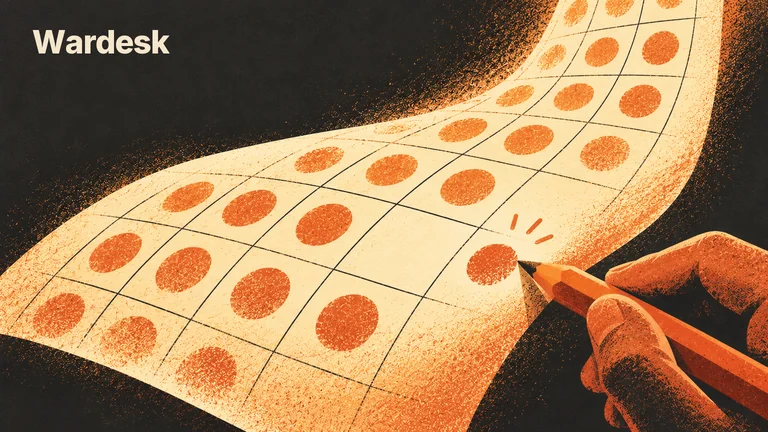
This is the design we chose for Wardesk. Habit streaks there count weeks, not days: a daily habit keeps its streak as long as you log it at least once in the Monday-to-Sunday week, and the current week stays open until it ends, so a missed Wednesday can't break anything on Wednesday night. A contribution grid still shows every day you actually showed up, so the forgiveness never hides the truth. If you change a habit's frequency, say from daily to three times a week, the streak you had is saved to history instead of reset to zero, and if streaks feel like pressure at all, you can switch them off in Settings without losing anything. No app required, though: a wall calendar with an X for each day you did it and a circle around every week that met its number is the same idea on paper.
Write your missed-day rule before you need it
The worst time to decide what a miss means is the night it happens. You're tired, the counter says zero, and the "what the hell" voice is already warmed up. So decide now, while you're calm. Copy this, fill in the blanks, and keep it wherever you track.
My missed-day rule
- The habit: ___
- The minimum version (what counts on my worst day): ___
- A good week is ___ of 7 days.
- After one miss: the minimum version on the next scheduled day. No doubling up, no catch-up session.
- After two misses in a row: one week of minimum versions only. Shrink it, don't quit it.
- What I'll say to myself: "One day is one day. The pattern is the habit."
I judge this habit by the week and the month, never by a single day.
Each line has a job. The minimum version stops a bad day from becoming a skipped day. The weekly number moves the scorecard from "perfect" to "enough." The next-day rule, with no doubling up, keeps the return cheap, which is exactly the behavior the gym megastudy found worth rewarding. And the sentence at the end is there because the story you tell yourself about a miss shapes the next day: recall that broken streaks hurt follow-through more when people pinned the break on themselves.
A worked example: Theo's missed Saturday
Theo has practiced piano every evening for 47 days, logging each session in an app with a hard daily streak. One calm Sunday a few weeks earlier, Theo filled in the rule card. Here's how the week of the miss goes.
The rule. Minimum version: play one piece once through, about four minutes. A good week: 5 of 7 days. After a miss: the minimum version the next day, no catch-up. After two misses in a row: a week of minimums. The sentence: "One day is one day."
Saturday, day 48. A friend's wedding, two hours away. Theo gets home after midnight and doesn't go near the piano. On Sunday morning the app shows a 0 where the 47 used to be.
Sunday morning. The old reflex arrives right on schedule: the streak is gone, it was a good run, maybe this is a sign to take a break. Theo reads the card instead. It doesn't ask for an hour of penance practice. It asks for four minutes.
Sunday night. One piece, once through, in socks, a little sloppy in the left hand. Logged.
The scorecard. By the week's measure, Theo played six days out of seven, one more than the target, so the week counts. By the month's, it's 29 of the last 30 days. Both numbers describe the same person the 0 described, and both are more accurate.
Monday. A new week and a clean page. Theo plays for twenty-five minutes, unprompted, because the piano no longer feels like the place where something died.
One decision made in advance did the work that motivation would otherwise have had to do on the worst possible morning.
How to come back after a broken streak
If you're reading this the morning after, with a zero looking back at you, here's the order of operations.
Change the number you look at. Swap "current streak" for "days out of the last 30" or "weeks that met their target." Your history didn't disappear; the counter just stopped describing it. Twenty-six of the last thirty days is a strong habit, whatever a streak counter says.
Restart small, on the next scheduled day. Do the minimum version, not a heroic catch-up session. A return that costs four minutes is a return you'll actually make.
Use fresh starts, but don't wait for one. New beginnings really do move people. Across three field studies, Google searches for "diet," gym visits, and sign-ups for goal commitments all rose after temporal landmarks such as a new week, month, or year, a birthday, or a holiday (Dai, Milkman and Riis, 2014). The authors' explanation is that landmarks open a fresh mental accounting period and file old imperfections under "before." A weekly measure hands you one of those every Monday, free. But a landmark is a bonus, not a precondition: if today is Wednesday, Wednesday is fine.
Blame the circumstance, accurately. "I missed because I was at a wedding" is kinder than "I always do this," and usually more true. It's also more useful, given what the streak research found about self-blame.
Gone for months, not days? Then the habit may need rebuilding rather than resuming. Our guide to starting over by rebuilding your routine in layers walks through the first four weeks, no perfect Monday required.
Do habit tracker apps work?
They can, and the reason is the tracking, not the app. The progress-monitoring meta-analysis above found real benefits from keeping score, with larger effects when progress was actually recorded, which a paper notebook does as well as any app. What decides whether a tracker helps you for a year or for a week is mostly what it does on your bad days. Before trusting one with something you care about, ask three questions.
- What happens on the day I come back? Imagine opening it after a week away. If the first thing you'd see is wreckage, it's built for your good days and will lose you on the bad ones.
- Does one miss cost more than one day? Any answer above "one day" is a tax on being human, and you're the one paying it.
- Is there anything that only grows? A total, a rate over time, a collection: some number no single bad week can erase. If everything can reset to zero, the app owns your progress. It should be the other way around.
If you're choosing one now, our guide to choosing a habit tracker app walks through seven things worth checking, starting with exactly this one. The same logic reaches past habits, too: a journal is a collection of entries, not a chain of days, which is why journals survive once they stop demanding streaks. And the principles underneath all of it are in the gentle productivity manifesto.
Questions people ask
Should I use a habit tracker app with streaks?
Is a habit tracker app or paper better?
Does gamification make a habit tracker app work better?
What should a habit tracker app for ADHD do?
How do you use a habit tracker?
- Harkin, B., Webb, T. L., Chang, B. P., Prestwich, A., Conner, M., Kellar, I., Benn, Y., & Sheeran, P. (2016). Does monitoring goal progress promote goal attainment? A meta-analysis of the experimental evidence. Psychological Bulletin, 142(2), 198–229. doi.org/10.1037/bul0000025
- Herman, C. P., & Mack, D. (1975). Restrained and unrestrained eating. Journal of Personality, 43(4), 647–660. doi.org/10.1111/j.1467-6494.1975.tb00727.x
- Silverman, J., & Barasch, A. (2023). On or off track: How (broken) streaks affect consumer decisions. Journal of Consumer Research, 49(6), 1095–1117. doi.org/10.1093/jcr/ucac029
- Lally, P., van Jaarsveld, C. H. M., Potts, H. W. W., & Wardle, J. (2010). How are habits formed: Modelling habit formation in the real world. European Journal of Social Psychology, 40(6), 998–1009. doi.org/10.1002/ejsp.674
- Singh, B., Murphy, A., Maher, C., & Smith, A. E. (2024). Time to form a habit: A systematic review and meta-analysis of health behaviour habit formation and its determinants. Healthcare, 12(23), 2488. doi.org/10.3390/healthcare12232488
- Milkman, K. L., Gromet, D., Ho, H., et al. (2021). Megastudies improve the impact of applied behavioural science. Nature, 600(7889), 478–483. doi.org/10.1038/s41586-021-04128-4
- Dai, H., Milkman, K. L., & Riis, J. (2014). The fresh start effect: Temporal landmarks motivate aspirational behavior. Management Science, 60(10), 2563–2582. doi.org/10.1287/mnsc.2014.1901
Habits that survive a missed day
Wardesk counts habit streaks by the week, keeps a grid of every day you showed up, and saves your streak to history when you change how often a habit repeats. Don't want streaks at all? Switch them off and lose nothing. It's free to try.
Try Wardesk free → No credit card. Your data stays yours.